
Things you should not have your clients put in a letter to a buyer or seller.
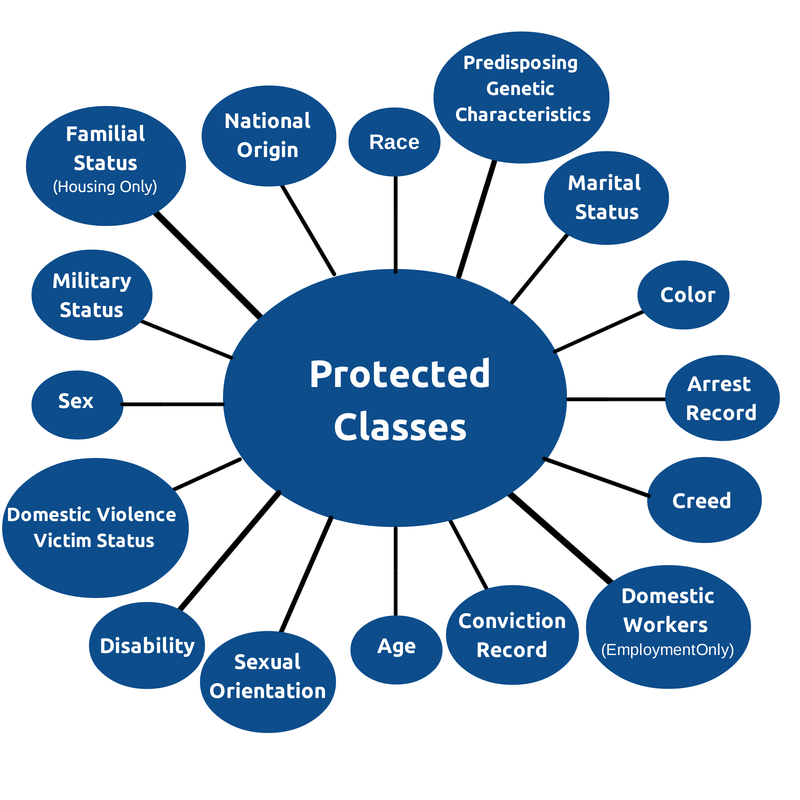
Protected Class
-
Race.
-
Color.
-
Religion or creed.
-
National origin or ancestry.
-
Sex.
-
Age.
-
Physical or mental disability.
-
Veteran status.
-
Genetic information.
-
Citizenship.More…
Discrimination is treating people differently. Discrimination is unlawful when it is based on a personal trait or characteristic protected under Human Rights Law. The traits that are protected under Human Rights Law are called Protected Classes. It is unlawful to discriminate against a member of a protected class when it comes to housing, employment, public accommodation, credit and lending, certain educational institutions, and volunteer firefighting organizations.
Rights
All citizens should be aware of their rights under Human Rights Law, including their right to file complaints against alleged acts of discrimination. In order for an alleged discriminatory act to be illegal, there must be a connection between what happened to you and the trait/characteristic protected by the Human Rights Law. Making a Human Rights complaint is free for the person making the complaint.Responsibilities
If you are an employer, housing professional, lending institution, or business, it is important to understand your responsibilities under the Human Rights Law. Awareness of the laws can help you create equitable environments in our community, as well as prevent costly and time-consuming legal proceedings.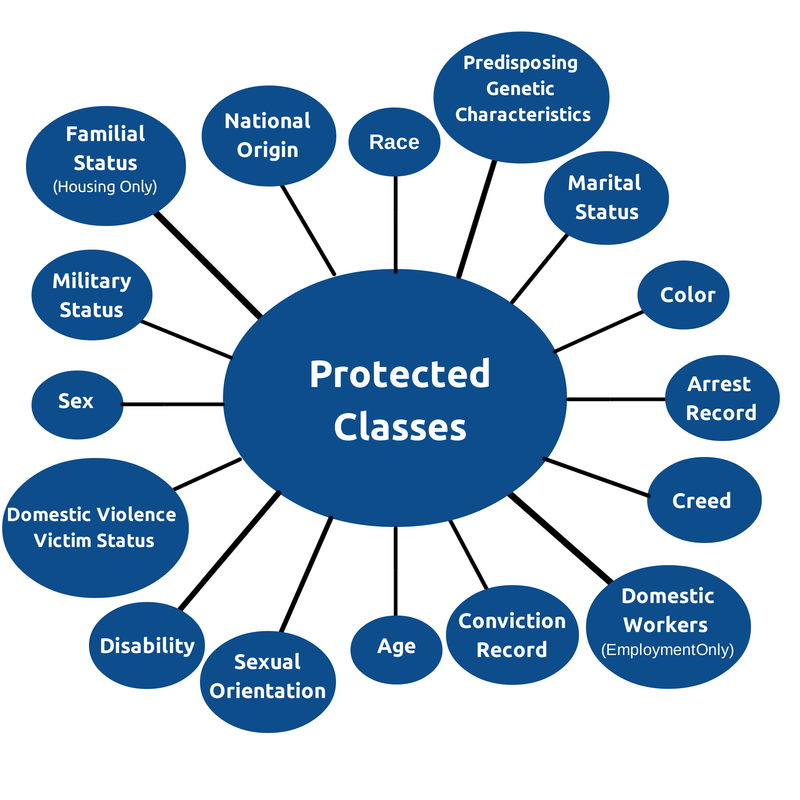
Descriptions of Protected Classes
Age
The Human Rights Law protects person(s) age 18 or older. A person cannot be discriminated against on the basis of his or her age in the area of employment or housing. Age discrimination usually occurs in employment when older workers are fired, replaced by younger workers, or treated differently than younger colleagues. Employees cannot be forced to retire except for very limited situations relative to tenured professors and certain highly paid executives.
Creed
Relates to a person’s religious beliefs. The wearing of religious garb and the observance of religious holidays and practices are protected under the Human Rights Law.
Race & Color
Race and color pertains to a person’s racial background and/or skin color.
Sex
Discrimination on the basis of sex includes unequal treatment in the workplace, sexual harassment, and pregnancy discrimination. Under the Human Rights Law, men and women are entitled to equal pay, benefits, working conditions, and seniority rights; men and women are entitled to be free from unwelcome sexual advances, requests for sexual favors, physical or verbal conduct of a sexual nature, and a hostile work environment; and pregnant women are guaranteed the right to work, and to enjoy the same medical, vacation and disability leave policies as non-pregnant co-workers. Although sex discrimination occurs most frequently in the workplace, it also occurs in areas concerning housing, credit, and public accommodations.
Sexual Orientation
The Sexual Orientation Non-Discrimination Act of January 16, 2003, amends the New York State Human Rights Law to prohibit actual or perceived sexual orientation discrimination in places of public accommodation, non-sectarian educational institutions, credit transactions, housing, commercial property, and in obtaining employment. Sexual Orientation is defined as gay, lesbian, bisexual, heterosexual, and asexual.
National Origin
Is based on one’s national group and includes one’s ancestry.
Marital Status
A person may not be discriminated against on the basis of whether or not he or she is married, divorced, single, separated or widowed.
Domestic Violence Victim Status
The New York State Human Rights Law was amended effective July 7, 2009 to provide protection from employment discrimination for victims of domestic violence. The Human Rights Law defines a domestic violence victim as an individual who is a victim of an act, which would constitute a family offense under N.Y. Family Court Act § 812. It is unlawful to discriminate against a domestic violence victim in employment and housing.
Disability
A disability is a physical, mental, or medical impairment resulting from anatomical, physiological, or neurological conditions that prevent the exercise of a normal bodily function or is demonstrable by clinical or laboratory diagnostics techniques. If a person has a record of a disability or is perceived by others to have a disability, whether or not the person does, he or she is also protected under the Human Rights Law. Under the jurisdiction of employment, a person is protected when the disability does not interfere with the ability to reasonably perform job duties. It is illegal to discriminate against people who have, are perceived to have, perceived to be at risk for HIV/AIDS.
Military Status
Discrimination on the basis of military status involves denying equal employment opportunity to any person because of that person’s past, current or future membership, service or obligation in a uniformed service.
Arrest & Conviction
It is unlawful for any person, agency, bureau, corporation or association, including the State and any political subdivision thereof, to deny employment because of an individual’s conviction record, where such denial is in violation of Article 23-a of the Correction Law. A potential employer cannot make any inquiry about an arrest record, but can inquire if a potential employee has been convicted of a crime.
Predisposing Genetic Characteristics
Employment discrimination on the basis of genetic predisposition or carrier status is prohibited by the Human Rights Law. The legislature added this protection to the law in 1996.
Familial Status (in housing only)
Discrimination in the rental, purchase, or lease of housing on the basis of familial status is prohibited. Familial status means any person who is pregnant, has a child, or is in the process of securing legal custody of any individual under the age of 18; or one or more individuals under the age of 18 living with a parent, a legal guardian, or a designee of a parent.
Domestic Workers (in employment only)
It is unlawful for an employer to engage in unwelcome sexual advances, requests for sexual favors, or other verbal or physical conduct of a sexual nature to a domestic worker when: (i) submission to such conduct is made either explicitly or implicitly a term or condition of an individual’s employment; (ii) submission to or rejection of such conduct by an individual is used as the basis for employment decisions affecting such individual; or (iii) such conduct has the purpose or effect of unreasonably interfering with an individual’s work performance by creating an intimidating, hostile, or offensive working environment.
Will 2026 Finally Jumpstart Home Sales?
High mortgage rates in 2025 slowed home sales, but improvement is expected starting in 2026. Experts predict existing home sales may ↑ 10–15% as conditions improve in 2026.
Homebuyers, Don’t Wait for a Miracle Rate
Mortgage rates increased after five weeks of declines, driven by stronger-than-expected economic indicators. Experts forecast minimal rate relief through late 2025 despite Federal Reserve predictions of future cuts. Waiting for rate drops may backfire as housing...
Slight Dip Ahead for U.S. Home Prices
U.S. home prices are projected to decline by 0.9% by Early-Q2 2026. The forecast reverses earlier predictions of price increases, signaling a cooling housing market.
Mortgage Rate Predictionsfor Q3 2025
Long Forecast predicts slight drops: July 6.84%, August 6.79%, September 6.74%. MBA expects 6.7% average in Q3; NAR, Realtor.com see 6.2%–6.4% by year-end. 15-year fixed rates forecasted to drop from 6.01% in July to 5.88% in September. Experts expect gradual rate...
Are mortgage rates falling? What homebuyers need to know
Mortgage rates for 30-year fixed loans have dropped to around 6.63%, the lowest since April, due to a weaker-than-expected jobs report causing Treasury yields to fall. Experts suggest this dip may be temporary but advise buyers to act now rather than wait for perfect...
The Salt Lake metro area is shifting to a renter’s market after an apartment construction boom.
Apartment vacancy rates rose to 7.1% in July, signaling an overbuilt market with slowed rent growth. Despite high rents, the market favors renters, with rent days on market decreasing. Utah's average rent dropped to $1,399 in 2025, causing many to delay home...
Forget Tariffs! There’s a New Crisis Impacting Rate Cuts
The Fed held rates at 4.25–4.5%, ignoring Trump’s calls for aggressive cuts. Trump imposed steep tariffs, triggering fears of price hikes on goods and vehicles.

How to Know if a Home Fits Your Lifestyle?
Research local schools even if you don’t have kids — they influence home values. Consider internet availability and speed, especially for remote work or streaming needs.
Are Buyers Really Optimistic About Housing?
Over half of U.S. buyers feel the market is better than last year, showing cautious optimism. Seventy-five percent of buyers are waiting for lower prices and interest rates before purchasing homes.
Why You Should Move to Utah
Suburbs of Salt Lake City are booming with new homes. Low unemployment and tech sector growth fuel migration. Affordable pricing compared to West Coast states. Access to skiing, hiking, and national parks. Ideal for families seeking active, balanced lifestyles.