2021 Real Estate Myth Buster

2021 Real Estate Myth Buster

2021 Real Estate Myth Buster

2021 Real Estate Myth Buster [INFOGRAPHIC] | MyKCM

Some Highlights

  • There are a lot of misconceptions about buying or selling a home today, making it challenging to know exactly how to navigate the current real estate landscape.
  • Here’s a little clarity when it comes to 5 common myths about the 2021 housing market.
  • Let’s connect to discuss your needs and so you can decipher facts from fiction in our local market.
What Credit Score Do You Need for a Mortgage?

What Credit Score Do You Need for a Mortgage?

What Credit Score Do You Need for a Mortgage?

What Credit Score Do You Need for a Mortgage? | MyKCM

According to data from the most recent Origination Insight Report by Ellie Mae, the average FICO® score on closed loans reached 753 in February. As lending standards have tightened recently, many are concerned over whether or not their credit score is strong enough to qualify for a mortgage. While stricter lending standards could be a challenge for some, many buyers may be surprised by the options that are still available for borrowers with lower credit scores.

The fact that the average American has seen their credit score go up in recent years is a great sign of financial health. As someone’s score rises, they’re building toward a stronger financial future. As more Americans with strong credit enter the housing market, we see a natural increase in the FICO® score distribution of closed loans, as shown in the graph below:What Credit Score Do You Need for a Mortgage? | MyKCMIf your credit score is below 750, it’s easy to see this data and fear that you may not be able to qualify for a mortgage. However, that’s not always the case. While the majority of borrowers right now do have a score above 750, there’s more to qualifying for a mortgage than just the credit score, and there are still options that allow people with lower credit scores to buy their dream home. Here’s what Experian, a global leader in consumer and business credit reporting, says:

  • Federal Housing Administration (FHA) loans: “With a 3.5% down payment, homebuyers may be able to get an FHA loan with a 580 credit score or higher. If you can manage a 10% down payment, though, that minimum goes as low as 500.”
  • Conventional loans: “The most popular loan type typically comes with a 620 minimum credit score.”
  • S. Department of Agriculture (USDA) loans: “In general, lenders require a minimum credit score of 640 for a USDA loan, though some may go as low as 580.”
  • S. Department of Veterans Affairs (VA) loans: “VA loans don’t technically have a minimum credit score, but lenders will typically require between 580 and 620.”

There’s no doubt a higher credit score will give you more options and better terms when applying for a mortgage, especially when lending is tight like it is right now. When planning to buy a home, speaking to an expert about steps you can take to improve your credit score is essential so you’re in the best position possible. However, don’t rule yourself out if your score is less than perfect – today’s market is still full of opportunity.

Bottom Line

Don’t let assumptions about whether your credit score is strong enough put a premature end to your homeownership goals. Let’s connect today to discuss the options that are best for you.

6 Simple Graphs Proving This Is Nothing Like Last Time

6 Simple Graphs Proving This Is Nothing Like Last Time

6 Simple Graphs Proving This Is Nothing Like Last Time

6 Simple Graphs Proving This Is Nothing Like Last Time | MyKCM

Last March, many involved in the residential housing industry feared the market would be crushed under the pressure of a once-in-a-lifetime pandemic. Instead, real estate had one of its best years ever. Home sales and prices were both up substantially over the year before. 2020 was so strong that many now fear the market’s exuberance mirrors that of the last housing boom and, as a result, we’re now headed for another crash.

However, there are many reasons this real estate market is nothing like 2008. Here are six visuals to show the dramatic differences.

1. Mortgage standards are nothing like they were back then.

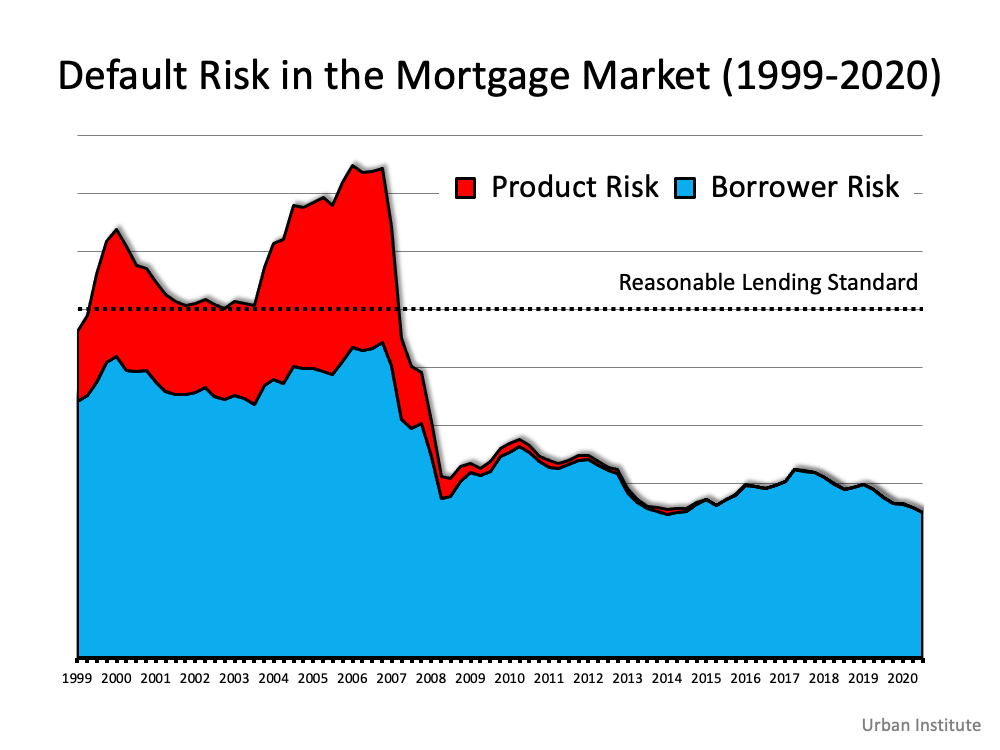
During the housing bubble, it was difficult not to get a mortgage. Today, it’s tough to qualify. Recently, the Urban Institute released their latest Housing Credit Availability Index (HCAI) which “measures the percentage of owner-occupied home purchase loans that are likely to default—that is, go unpaid for more than 90 days past their due date. A lower HCAI indicates that lenders are unwilling to tolerate defaults and are imposing tighter lending standards, making it harder to get a loan. A higher HCAI indicates that lenders are willing to tolerate defaults and are taking more risks, making it easier to get a loan.”

The index shows that lenders were comfortable taking on high levels of risk during the housing boom of 2004-2006. It also reveals that today, the HCAI is under 5 percent, which is the lowest it’s been since the introduction of the index. The report explains:

“Significant space remains to safely expand the credit box. If the current default risk was doubled across all channels, risk would still be well within the pre-crisis standard of 12.5 percent from 2001 to 2003 for the whole mortgage market.”
6 Simple Graphs Proving This Is Nothing Like Last Time | MyKCMThis is nothing like the last time.

2. Prices aren’t soaring out of control.

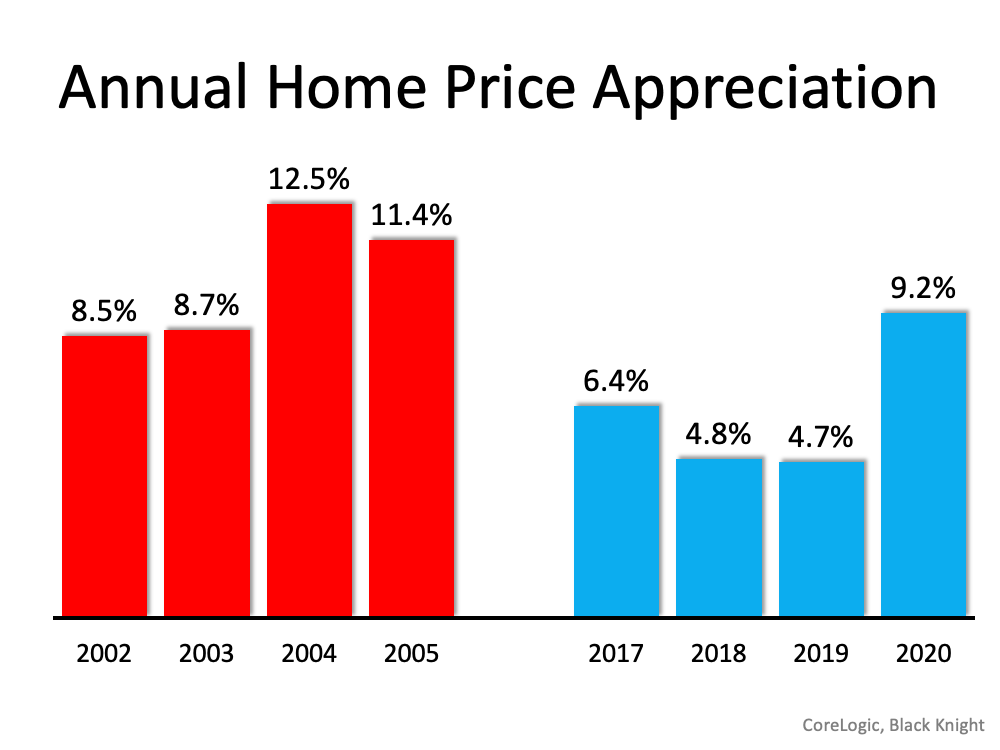
Below is a graph showing annual home price appreciation over the past four years compared to the four years leading up to the height of the housing bubble. Though price appreciation was quite strong last year, it’s nowhere near the rise in prices that preceded the crash.6 Simple Graphs Proving This Is Nothing Like Last Time | MyKCMThere’s a stark difference between these two periods of time. Normal appreciation is 3.8%. So, while current appreciation is higher than the historic norm, it’s certainly not accelerating out of control as it did in the early 2000s.
This is nothing like the last time.

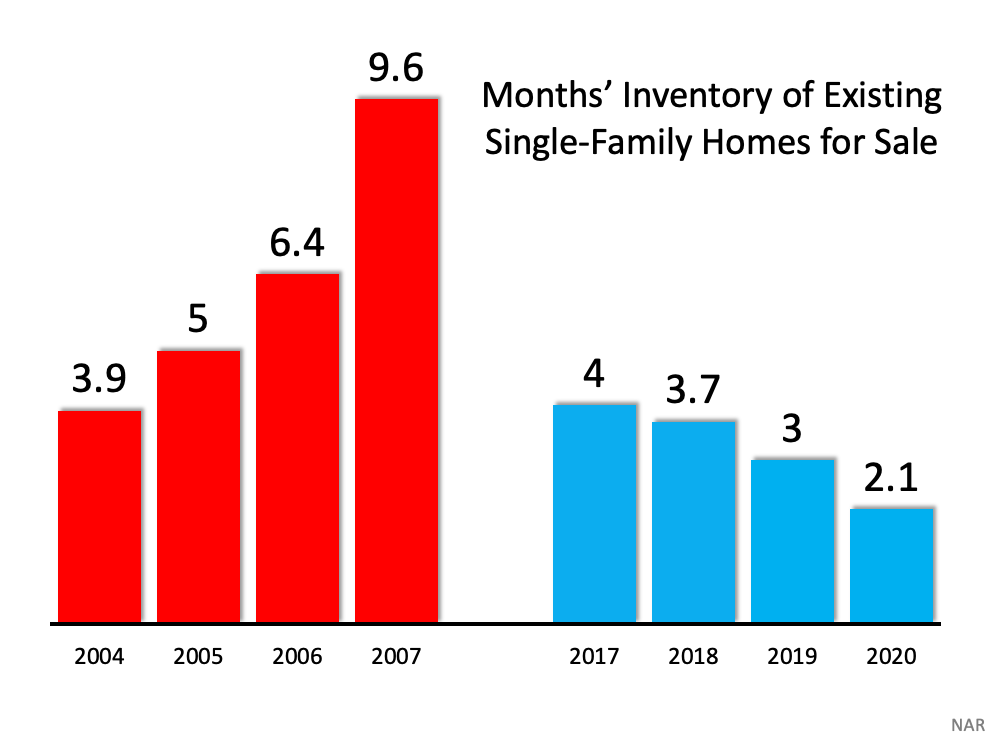
3. We don’t have a surplus of homes on the market. We have a shortage.

The months’ supply of inventory needed to sustain a normal real estate market is approximately six months. Anything more than that is an overabundance and will causes prices to depreciate. Anything less than that is a shortage and will lead to continued appreciation. As the next graph shows, there were too many homes for sale in 2007, and that caused prices to tumble. Today, there’s a shortage of inventory, which is causing an acceleration in home values.6 Simple Graphs Proving This Is Nothing Like Last Time | MyKCMThis is nothing like the last time.
4. New construction isn’t making up the difference in inventory needed.

Some may think new construction is filling the void. However, if we compare today to right before the housing crash, we can see that an overabundance of newly built homes was a major challenge then, but isn’t now.6 Simple Graphs Proving This Is Nothing Like Last Time | MyKCMThis is nothing like the last time.
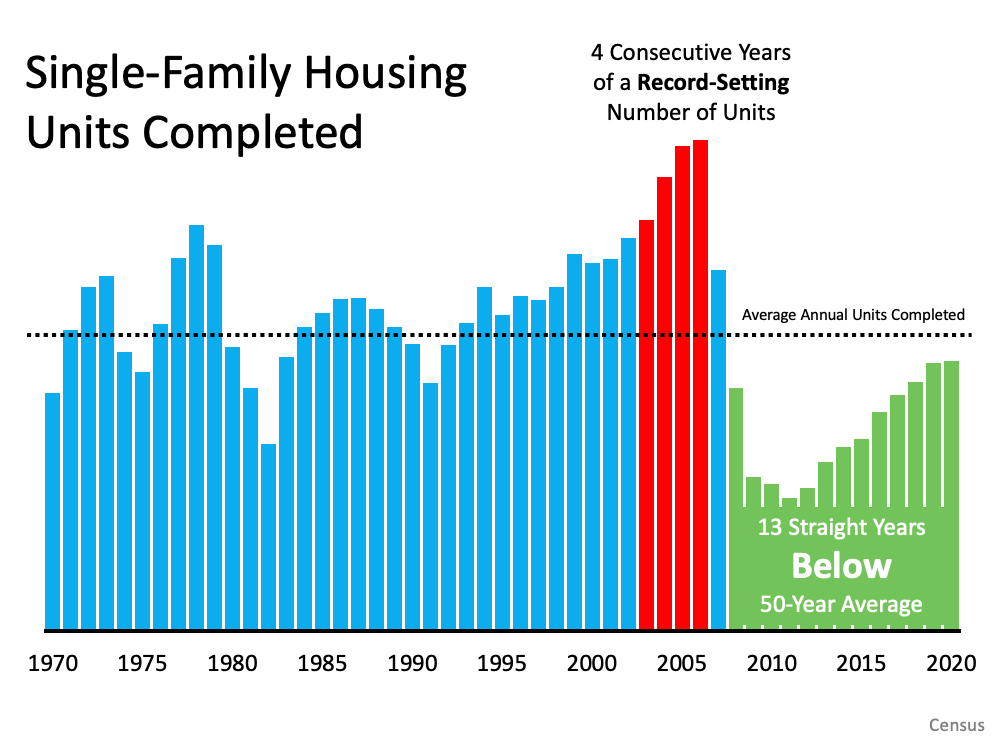
5. Houses aren’t becoming too expensive to buy.

The affordability formula has three components: the price of the home, the wages earned by the purchaser, and the mortgage rate available at the time. Fifteen years ago, prices were high, wages were low, and mortgage rates were over 6%. Today, prices are still high. Wages, however, have increased, and the mortgage rate is about 3%. That means the average homeowner pays less of their monthly income toward their mortgage payment than they did back then. Here’s a chart showing that difference:6 Simple Graphs Proving This Is Nothing Like Last Time | MyKCMAs Mark Fleming, Chief Economist for First American, explains:
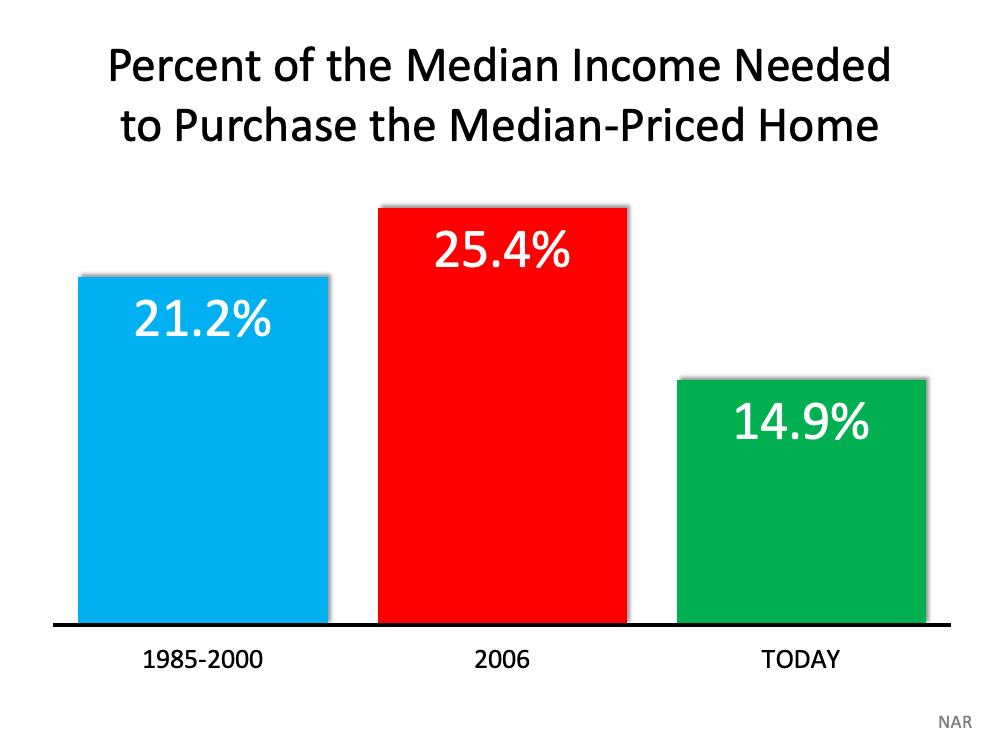
“Lower mortgage interest rates and rising incomes correspond with higher house prices as home buyers can afford to borrow and buy more. If housing is appropriately valued, house-buying power should equal or outpace the median sale price of a home. Looking back at the bubble years, house prices exceeded house-buying power in 2006, but today house-buying power is nearly twice as high as the median sale price nationally.”

This is nothing like the last time.

6. People are equity rich, not tapped out.

In the run-up to the housing bubble, homeowners were using their homes as personal ATM machines. Many immediately withdrew their equity once it built up, and they learned their lesson in the process. Prices have risen nicely over the last few years, leading to over 50% of homes in the country having greater than 50% equity – and owners have not been tapping into it like the last time. Here’s a table comparing the equity withdrawal over the last three years compared to 2005, 2006, and 2007. Homeowners have cashed out almost $500 billion dollars less than before:6 Simple Graphs Proving This Is Nothing Like Last Time | MyKCMDuring the crash, home values began to fall, and sellers found themselves in a negative equity situation (where the amount of the mortgage they owed was greater than the value of their home). Some decided to walk away from their homes, and that led to a wave of distressed property listings (foreclosures and short sales), which sold at huge discounts, thus lowering the value of other homes in the area. With the average home equity now standing at over $190,000, this won’t happen today.
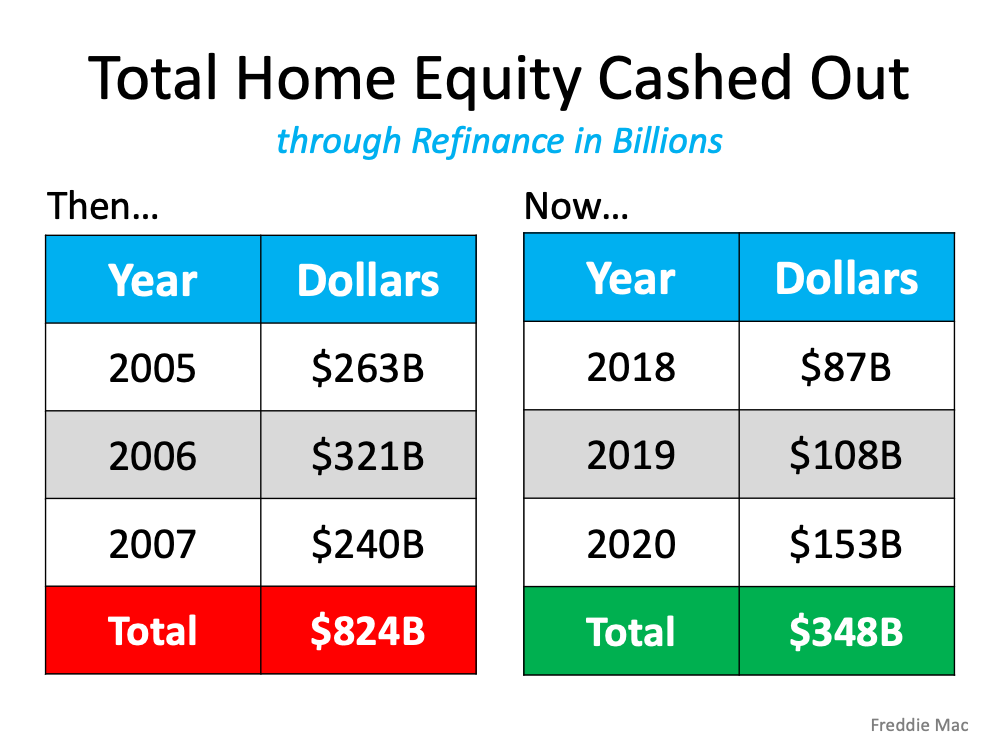
This is nothing like the last time.

Bottom Line

If you’re concerned that we’re making the same mistakes that led to the housing crash, take a look at the charts and graphs above to help alleviate your fears.


5 Reasons to Sell Your House This Spring

5 Reasons to Sell Your House This Spring

5 Reasons to Sell Your House This Spring

5 Reasons to Sell Your House This Spring | MyKCM

When selling a house, most homeowners hope for a quick and profitable transaction that puts them in a position to make a great move. If you’re waiting for the best time to win as a seller, the market is calling your name this spring. Here are five reasons why this is the perfect time to sell your house if you’re ready.

1. There’s high demand from homebuyers.

Buyer demand is strong right now, and buyers are active in the market. ShowingTime, which tracks the average number of buyer showings on residential properties, recently announced that buyer showings are up 51.5% compared to this time last year. Daniil Cherkasskiy, Chief Analytics Officer at ShowingTime, notes:

“As anticipated, demand for real estate remains elevated and continues to be affected by low levels of inventory…On average, each home is getting 50 percent or more requests this year compared to January of last year. As we head into the busy season, it’s likely we’ll push into even more extreme territory until the supply starts catching up with demand.”

When your house is positioned to get a ton of attention from competitive buyers, you’re in the best spot possible as the seller.

2. There aren’t enough houses for sale.

Purchaser demand is so high, the market is running out of available houses for sale. Recently, realtor.com reported:

“Nationally, the inventory of homes for sale in February decreased by 48.6% over the past year, a higher rate of decline compared to the 42.6% drop in January. This amounted to 496,000 fewer homes for sale compared to February of last year.”

The National Association of Realtors (NAR) also reveals that, while home sales are skyrocketing, the inventory of existing homes for sale is continuing to drop dramatically. Houses are essentially selling as fast as they’re hitting the market – in fact, NAR reports that the average house is on the market for only 21 days.

It’s this imbalance between high buyer demand and a low supply of houses for sale that gives sellers such an advantage. A seller will always negotiate the best deal when demand is high and supply is low. That’s exactly what’s happening in the real estate market today.

3. You have a lot of leverage in today’s market.

Clearly, many more people are interested in buying than selling this spring, creating the ultimate sellers’ market. When this happens, homeowners in a position to sell have the upper hand in negotiations.

According to NAR, agents are reporting an average of 3.7 offers per house and an increase in bidding wars. As a seller, this means the ball is in your court – so much so that you can use your leverage to negotiate the best possible contract. Demand is there, and now is the perfect time to sell for the most favorable terms.

4. It’s a great way to use your home equity.

According to the latest data from CoreLogic, as of the third quarter of 2020, the average homeowner gained $17,000 in equity over the past year, and that number continues to grow as home values appreciate. Equity is a type of forced savings that grows during your time as a homeowner and can be put toward bigger goals like buying your next dream home.

Mark Fleming, Chief Economist at First American, notes:

“As homeowners gain equity in their homes, they are more likely to consider using that equity to purchase a larger or more attractive home – the wealth effect of rising equity. In today’s housing market, fast rising demand against the limited supply of homes for sale has resulted in continued house price appreciation.”

5. It’s a chance to find a home that meets your needs.

So much has changed over the past year, including what many of us need in a home. Spending extra time where we currently live is enabling many of us to re-evaluate homeownership and what we find most important in a home.

Whether it’s a house that has the features suited to working remotely, space for virtual or hybrid schooling, a home gym or theater, or something else, selling this spring gives you a chance to make a move and find the home of your dreams.

Bottom Line

Today’s housing market belongs to the sellers. If you’ve considered making a move but have been waiting for the right market conditions, your wait may be over. Let’s connect so you’ll be positioned to win when you sell your house this spring.


How to Prepare Your House for a Winning Sale This Spring

How to Prepare Your House for a Winning Sale This Spring

How to Prepare Your House for a Winning Sale This Spring 

How to Prepare Your House for a Winning Sale This Spring [INFOGRAPHIC] | MyKCM

Some Highlights

  • With so few homes available to buy today, houses are in high demand, and they’re selling fast.
  • That means it’s a great time to sell if you’re ready to make a move.
  • Let’s connect to make sure your house is ready for a top-dollar sale this spring. It may be closer than you think!
Is It a Good Time to Sell My House in Utah

Is It a Good Time to Sell My House in Utah

Is It a Good Time to Sell My House In Utah?

Is It a Good Time to Sell My House? | MyKCM

Last year, many homeowners thought twice about selling their houses due to the onset of the health crisis. This year, however, homeowners are beginning to regain their confidence when it comes to selling safely. The latest Home Purchase Sentiment Index (HPSI) by Fannie Mae shows that 57% of consumers believe now is a good time to sell.

Doug Duncan, Vice President and Chief Economist at Fannie Mae, explains:

“Overall, the index’s monthly increase was driven largely by a substantial jump in the share of consumers reporting that it’s a good time to sell a home, with many citing favorable mortgage rates, high home prices, and low housing inventory as their primary rationale.”

Normally, spring is the busiest season in the housing market – the time when many homeowners decide to list their houses. While this is obviously not a normal year since the pandemic is still very much upon us, experts are optimistic that consumer positivity around selling will lead to more homeowners making moves this year. Duncan continues to say:

“We will pay close attention to see if this newfound optimism develops into a trend.”

What does this mean if you’re thinking of selling your house?

The fact that there are so few houses available for sale today is one driver that’s encouraging consumers to think more positively about selling. The National Association of Realtors (NAR) states:

“Total housing inventory at the end of January amounted to 1.04 million units, down 1.9% from December and down 25.7% from one year ago (1.40 million).”

With so few homes available to buy, your house will be more likely to rise to the top of an eager purchaser’s wish list in this competitive market. Today’s high buyer activity is creating upward pressure on home prices and more multiple-offer scenarios. According to the Realtors Confidence Index Survey from NAR, the average home for sale is receiving 3.7 offers today, up from 2.3 offers just one year ago. This makes selling even more enticing.

In this kind of sellers’ market, you have a huge advantage in the process. And here’s another win – you can also use your equity toward a down payment on a new home when you move.

Wondering where you’ll go if you try to move while it’s so challenging to find a home to buy? Well, in many areas, there are more homes available at the higher end of the market, so finding a move-up home may be less of an issue if you’re ready to search for your dream home this spring.

Bottom Line

If you pressed pause on selling your house last year, now may be the best time to put your plans back into motion while inventory is so low. Let’s connect today to get the process started.

Looking to sell your home in this intense real estate market?

Looking to sell your home in this intense real estate market?

Looking to sell your home in this intense real estate market?


Looking to sell your home in this intense real estate market?

 
If you are, it’s possible you will receive multiple offers on your home depending on its condition, location and price. Reviewing multiple offers to make sure you pick the best one is much more than just looking at the offer price.
Here is a list of 25 potential questions you will need to be able to answer when reviewing offers and working through the transaction:
1) How much is the earnest money?
2) When does the earnest money become non-refundable for the buyer?
3) When will the transaction close?
4) Was the contract properly filled out and legally binding?
5) Are the correct signatures on the contract?
6) What is the offer price? What are the net proceeds to the seller?
7) Does the buyer have the right to do a home inspection?
8)What is the buyer’s inspection deadline, if any?
9) Is there an appraisal contingency, if so, what is the deadline?
10) Is there a financing contingency, if so, what is the deadline?
11) Does the buyer have to first sell their home in order to qualify to purchase the new home? If so, by what deadline?
12) Who is paying the closing costs? Are they being split?
13) After the transaction closes, when is the seller required to deliver possession of the home?
14) When is the seller disclosure deadline? Is there enough time to provide all the necessary legal disclosures?
15) Who pays for the HOA transfer fee?
16) What items are included with the sale? Can I remove my Ring doorbell and Nest thermostat?
17) Are any items of personal property excluded from the sale?
18) What type of title insurance policy am I required to provide the buyer?
19) Do I have to provide and pay for a home warranty plan?
20) Is there any additional earnest money that buyer will deliver during the escrow stage of the transaction that could become non-refundable making the offer stronger?
21) Will the buyer allow me to rent back if needed?
22) What is the deadline to accept the offer?
23) Does the buyer’s agent have enough expertise and experience to get the job done?
24) Where is the earnest money going to be held until closing?
25) If the appraisal comes in low, what happens?
If any of this doesn’t make sense, consult your experienced Realtor® to help you make the right choice.
Courtesy, Curtis Bullock CEO of the Salt Lake Board of Realtors
How Smart Is It to Buy a Home Today

How Smart Is It to Buy a Home Today

How Smart Is It to Buy a Home Today?

How Smart Is It to Buy a Home Today? | MyKCM

Whether you’re buying your first home or selling your current house, if your needs are changing and you think you need to move, the decision can be complicated. You may have to take personal or professional considerations into account, and only you can judge what impact those factors should have on your desire to move.

However, there’s one category that provides a simple answer. When deciding to buy now or wait until next year, the financial aspect of the purchase is easy to evaluate. You just need to ask yourself two questions:

  1. Do I think home values will be higher a year from now?
  2. Do I think mortgage rates will be higher a year from now?

From a purely financial standpoint, if the answer is ‘yes’ to either question, you should strongly consider buying now. If the answer to both questions is ‘yes,’ you should definitely buy now.

Nobody can guarantee what home values or mortgage rates will be by the end of this year. The experts, however, seem certain the answer to both questions above is a resounding ‘yes.’ Mortgage rates are expected to rise and home values are expected to appreciate rather nicely.

What does this mean to you?

Let’s look at how waiting would impact your financial situation. Here are the assumptions made for this example:

  • The experts are right – mortgage rates will be 3.18% at the end of the year
  • The experts are right – home values will appreciate by 5.9%
  • You want to buy a home valued at $350,000 today
  • You decide on a 10% down payment

How Smart Is It to Buy a Home Today? | MyKCMHere’s the financial impact of waiting:

  • You pay an extra $20,650 for the house
  • You need an additional $2,065 for a down payment
  • You pay an extra $116/month in your mortgage payment ($1,392 additional per year)
  • You don’t gain the $20,650 increase in wealth through equity build-up

Bottom Line

There are many things to consider when buying a home. However, from a purely financial aspect, if you find a home that meets your needs, buying now makes much more sense than buying next year.

Pin It on Pinterest