
Renting or Selling Your House: What’s the Best Move?

Renting or Selling Your House: What’s the Best Move?

Renting or Selling Your House: What’s the Best Move?

If you’re a homeowner ready to make a move, you may be thinking about using your current house as a short-term rental property instead of selling it. A short-term rental (STR) is typically offered as an alternative to a hotel, and they’re an investment that’s gained popularity in recent years.

While a short-term rental can be a tempting idea, you may find the reality of being responsible for one difficult to take on. Here are some of the challenges you could face if you rent out your house instead of selling it.

A Short-Term Rental Comes with Responsibilities

Successfully managing your house as a short-term rental takes a lot of time and effort. You’ll have to juggle tasks like dealing with reservations, organizing check-ins, and tackling cleaning, landscape, and maintenance duties. Any one of those can feel demanding, but all together it’s a lot to handle.

Short-term rentals experience high turnover rates, as new guests check in and out frequently. This home traffic can lead to increased wear and tear on your property—meaning you may need to make more frequent repairs or replace your furniture, fixtures, and appliances more often.

Think through your ability to make that level of commitment, especially if you plan to use a platform that advertises your rental listing. Most of them have specific requirements hosts must meet. An article from Bankrate explains:

“Managing a rental property can be time-consuming and challenging. Are you handy and able to make some repairs yourself? If not, do you have a network of affordable contractors you can reach out to in a pinch? Consider whether you want to take on the added responsibility of being a landlord, which means screening tenants and fielding issues, among other responsibilities, or paying for a third party to take care of things instead.”

There’s a lot to consider before taking the leap and converting your house into a short-term rental. If you aren’t ready for the work it takes, it could be wise to sell instead.

Short-Term Rental Regulations

As the short-term rental industry continues to grow, regulations have increased. Legal restrictions commonly include limits on the number of vacation rentals in a particular location. This is especially true in larger cities and tourist destinations where there may be concerns about overcrowding or housing shortages for permanent residents. Restrictions may also apply to the type of property that can be used for short-term rentals.

Many cities also require homeowners to obtain a license or permit before renting out their properties. Nick Del Pego, CEO at Deckard Technologies, explains:

“Renting short-term rentals is considered a business by most local governments, and owners must comply with specific workplace regulations and business licensing rules established in their local communities.”

It is important to thoroughly check whether short-term rentals are regulated or prohibited by the local government and your homeowners association (HOA) before even considering renting out your home.

Bottom Line

Converting your home into a short-term rental isn’t a decision you should make without doing your research. To decide if selling your house is a better alternative, let’s connect today.

Today’s Housing Inventory Is a Sweet Spot for Sellers

Today’s Housing Inventory Is a Sweet Spot for Sellers

Today’s Housing Inventory Is a Sweet Spot for Sellers

One of the biggest challenges in the housing market right now is how few homes there are for sale compared to the number of people who want to buy them. To help emphasize just how limited housing inventory still is, let’s take a look at the latest information on active listings, or homes for sale in a given month, as it compares to more normal levels.

According to a recent report from Realtor.com:

 “On average, active inventory in June was 50.6% below pre-pandemic 2017–2019 levels.”

The graph below helps illustrate this point. It uses historical data to provide a more concrete look at how much the numbers are still lagging behind the level of inventory typical of a more normal market (see graph below):

It’s worth noting that 2020-2022 are not included in this graph. That’s because they were truly abnormal years for the housing market. To make the comparison fair, those have been omitted so they don’t distort the data.

When you compare the orange bars for 2023 with the last normal years for the housing market (2017-2019), you can see the count of active listings is still far below the norm.

What Does This Mean for You?

If you’re thinking about selling your house, that low inventory is why this is a great time to do so. Buyers have fewer choices now than they did in more normal years, and that’s continuing to impact some key statistics in the housing market. For example, sellers will be happy to see the following data from the latest Confidence Index from the National Association of Realtors (NAR):

  • The percent of homes that sold in less than a month ticked up slightly to 74%.
  • The median days on market went down to 18 days, showing homes are still selling fast when priced right.
  • The average number of offers on recently sold homes went up to 3.3 offers.

Bottom Line

When supply is so low, your house is going to be in the spotlight. That’s why sellers are seeing their homes sell a little faster and get more offers right now. If you’ve thought about selling, now’s the time to make a move. Let’s connect to get the process started.

Marty Gale

Buy or Sell with Marty Gale

"Its The Experience"

Principal Broker and Owner of Utah Realty™

Licensed Since 1986

CERTIFIED LUXURY HOME MARKETING SPECIALIST (CLHM)

PSA  (Pricing Strategy Advisor)

General Contractor 2000 (in-active)
e-pro (advanced digital marketing) 2001
Certified Residential Specialist 2009

Certified Negotiation Expert 2014

Master Certified Negotiation Expert 2014
Certified Probate Specialist Since 2018

Senior Real Estate Specialist

Certified Divorce Specialist CDS


Contact me! 


Two Questions To Ask Yourself if You’re Considering Buying a Home

Two Questions To Ask Yourself if You’re Considering Buying a Home

Two Questions To Ask Yourself if You’re Considering Buying a Home

If you’re thinking of buying a home, chances are you’re paying attention to just about everything you hear about the housing market. And you’re getting your information from a variety of channels: the news, social media, your real estate agent, conversations with friends and loved ones, overhearing someone chatting at the local supermarket, the list goes on and on. Most likely, home prices and mortgage rates are coming up a lot.

To help cut through the noise and give you the information you need most, take a look at what the data says. Here are the top two questions you need to ask yourself about home prices and mortgage rates as you make your decision:

1. Where Do I Think Home Prices Are Heading?

One reliable place you can turn to for that information is the Home Price Expectation Survey from Pulsenomics – a survey of a national panel of over one hundred economists, real estate experts, and investment and market strategists.

According to the latest release, the experts surveyed are projecting slight depreciation this year (see the red in the graph below). But here’s the context you need most. The worst home price declines are already behind us, and prices are actually appreciating again in many markets. Not to mention, the small 0.37% depreciation HPES is showing for 2023 is far from the crash some people originally said would happen.

Now, let’s look to the future. The green in the graph below shows prices have turned a corner and are expected to appreciate in 2024 and beyond. After this year, the HPES is forecasting home price appreciation returning to more normal levels for the next several years.

So, why does this matter to you? It means your home will likely grow in value and you should gain home equity in the years ahead, but only if you buy now. If you wait, based on these forecasts, the home will only cost you more later on.

2. Where Do I Think Mortgage Rates Are Heading?

Over the past year, mortgage rates have risen in response to economic uncertainty, inflation, and more. We know based on the latest reports that inflation, while still high, has moderated from its peak. This is an encouraging sign for the market and for mortgage rates. Here’s why.

When inflation cools, mortgage rates generally fall in response. This may be why some experts are saying mortgage rates will pull back slightly over the next few quarters and settle somewhere around roughly 5.5 and 6% on average.

But, not even the experts can say with absolute certainty where mortgage rates will be next year, or even next month. That’s because there are so many factors that can impact what happens. So, to give you a lens into the various possible outcomes, here’s what you should consider:

  • If you buy now and mortgage rates don’t change: You made a good move since home prices are projected to grow with time, so at least you beat rising prices.
  • If you buy now and mortgage rates fall (as projected): You probably still made a good decision because you got the house before home prices appreciated more. And, you can always refinance your home later on if rates are lower.
  • If you buy now and mortgage rates rise: If this happens, you made a great decision because you bought before both the price of the home and the mortgage rate went up.

Bottom Line

If you’re thinking about buying a home, you need to know the facts on what’s happening with home prices and mortgage rates. While no one can say for certain where they’ll go, expert projections can give you powerful information to keep you informed. Let’s connect so you have a professional to add in an expert opinion on our local market.

Marty Gale

Buy or Sell with Marty Gale

"Its The Experience"

Principal Broker and Owner of Utah Realty™

Licensed Since 1986

CERTIFIED LUXURY HOME MARKETING SPECIALIST (CLHM)

PSA  (Pricing Strategy Advisor)

General Contractor 2000 (in-active)
e-pro (advanced digital marketing) 2001
Certified Residential Specialist 2009

Certified Negotiation Expert 2014

Master Certified Negotiation Expert 2014
Certified Probate Specialist Since 2018

Senior Real Estate Specialist

Certified Divorce Specialist CDS


Contact me! 


Key Reasons To Use a Real Estate Agent When You Sell

Key Reasons To Use a Real Estate Agent When You Sell

Key Reasons To Use a Real Estate Agent When You Sell

Some Highlights

  • An agent is a really important part of selling your home because they bring a lot of skill and expertise to the sales process.
  • They’ll explain what’s happening today, what that means for you, and how to price and market your house. They’re also skilled negotiators and well versed in the contracts and disclosures involved.
  • Let’s connect to ensure you have an expert helping you sell your house successfully.

Marty Gale

Buy or Sell with Marty Gale

"Its The Experience"

Principal Broker and Owner of Utah Realty™

Licensed Since 1986

CERTIFIED LUXURY HOME MARKETING SPECIALIST (CLHM)

PSA  (Pricing Strategy Advisor)

General Contractor 2000 (in-active)
e-pro (advanced digital marketing) 2001
Certified Residential Specialist 2009

Certified Negotiation Expert 2014

Master Certified Negotiation Expert 2014
Certified Probate Specialist Since 2018

Senior Real Estate Specialist

Certified Divorce Specialist CDS


Contact me! 


Lending Standards Are Not Like They Were Leading Up to the Crash

Lending Standards Are Not Like They Were Leading Up to the Crash

Lending Standards Are Not Like They Were Leading Up to the Crash

You might be worried we’re heading for a housing crash, but there are many reasons why this housing market isn’t like the one we saw in 2008. One of which is how lending standards are different today. Here’s a look at the data to help prove it.

Every month, the Mortgage Bankers Association (MBA) releases the Mortgage Credit Availability Index (MCAI). According to their website:

“The MCAI provides the only standardized quantitative index that is solely focused on mortgage credit. The MCAI is . . . a summary measure which indicates the availability of mortgage credit at a point in time.”

Basically, the index determines how easy it is to get a mortgage. Take a look at the graph below of the MCAI since they started keeping track of this data in 2004. It shows how lending standards have changed over time. It works like this:

  • When lending standards are less strict, it’s easier to get a mortgage, and the index (the green line in the graph) is higher.
  • When lending standards are stricter, it’s harder to get a mortgage, and the line representing the index is lower.

In 2004, the index was around 400. But, by 2006, it had gone up to over 850. Today, the story is quite different. Since the crash, the index went down because lending standards got tighter, so today it’s harder to get a mortgage.

Loose Lending Standards Contributed to the Housing Bubble

One of the main factors that contributed to the housing bubble was that lending standards were a lot less strict back then. Realtor.com explains it like this:

“In the early 2000s, it wasn’t exactly hard to snag a home mortgage. . . . plenty of mortgages were doled out to people who lied about their incomes and employment, and couldn’t actually afford homeownership.”

The tall peak in the graph above indicates that leading up to the housing crisis, it was much easier to get credit, and the requirements for getting a loan were far from strict. Back then, credit was widely available, and the threshold for qualifying for a loan was low.

Lenders were approving loans without always going through a verification process to confirm if the borrower would likely be able to repay the loan. That means creditors were lending to more borrowers who had a higher risk of defaulting on their loans.

Today’s Loans Are Much Tougher To Get than Before

As mentioned, lending standards have changed a lot since then. Bankrate describes the difference:

“Today, lenders impose tough standards on borrowers – and those who are getting a mortgage overwhelmingly have excellent credit.”

If you look back at the graph, you’ll notice after the peak around the time of the housing crash, the line representing the index went down dramatically and has stayed low since. In fact, the line is far below where standards were even in 2004 – and it’s getting lower. Joel Kan, VP and Deputy Chief Economist at MBA, provides the most recent update from May:

“Mortgage credit availability decreased for the third consecutive month . . . With the decline in availability, the MCAI is now at its lowest level since January 2013.”

The decreasing index suggests standards are getting much tougher – which makes it clear we’re far away from the extreme lending practices that contributed to the crash.

Bottom Line

Leading up to the housing crash, lending standards were much more relaxed with little evaluation done to measure a borrower’s potential to repay their loan. Today, standards are tighter, and the risk is reduced for both lenders and borrowers. This goes to show, these are two very different housing markets, and this market isn’t like the last time.

Marty Gale

Buy or Sell with Marty Gale

"Its The Experience"

Principal Broker and Owner of Utah Realty™

Licensed Since 1986

CERTIFIED LUXURY HOME MARKETING SPECIALIST (CLHM)

PSA  (Pricing Strategy Advisor)

General Contractor 2000 (in-active)
e-pro (advanced digital marketing) 2001
Certified Residential Specialist 2009

Certified Negotiation Expert 2014

Master Certified Negotiation Expert 2014
Certified Probate Specialist Since 2018

Senior Real Estate Specialist

Certified Divorce Specialist CDS


Contact me! 


Why Homeownership Wins in the Long Run

Why Homeownership Wins in the Long Run

Why Homeownership Wins in the Long Run

Today’s higher mortgage rates, inflationary pressures, and concerns about a potential recession have some people questioning: should I still buy a home this year? While it’s true this year has unique challenges for homebuyers, it’s important to think about the long-term benefits of homeownership when making your decision.

Consider this: if you know people who bought a home 5, 10, or even 30 years ago, you’re probably going to have a hard time finding someone who regrets their decision. Why is that? The reason is tied to how home values grow with time and how, by extension, that grows your own wealth. That may be why, in a recent Fannie Mae survey, 70% of respondents say they believe buying a home is a safe investment.

Here’s a look at how just the home price appreciation piece can really add up over the years.

Home Price Growth over Time

The map below uses data from the Federal Housing Finance Agency (FHFA) to show just how noteworthy price gains have been over the last five years. And, since home prices vary by area, the map is broken out regionally to help convey larger market trends.

If you look at the percent change in home prices, you can see home prices grew on average by just over 56% nationwide over a five-year period.

Some regions are slightly above or below that average, but overall, home prices gained solid ground in a short time. And if you expand that time frame even more, the benefit of homeownership and the drastic gains homeowners made over the years become even clearer (see map below):

The second map shows, nationwide, home prices appreciated by an average of over 290% over a roughly 30-year span.

This nationwide average tells you the typical homeowner who bought a house 30 years ago saw their home almost triple in value over that time. That’s a key factor in why so many homeowners who bought their homes years ago are still happy with their decision.

And while you may have heard talk in late 2022 that home prices would crash, it didn’t happen. Even though home prices have moderated from the record peak we saw during the ‘unicorn’ years, prices are already rebounding in many areas today. That means, in most markets, your home should grow in value over the next year.

The alternative to buying a home is renting, and rental prices have been climbing for decades. So why rent and deal with annual lease hikes for no long-term financial benefit? Instead, consider buying a home.

Bottom Line

If you’re questioning if it still makes sense to buy a home today, remember the incredible long-term benefits of homeownership. If you’re ready to start the conversation, let’s connect today.

Marty Gale

Buy or Sell with Marty Gale

"Its The Experience"

Principal Broker and Owner of Utah Realty™

Licensed Since 1986

CERTIFIED LUXURY HOME MARKETING SPECIALIST (CLHM)

PSA  (Pricing Strategy Advisor)

General Contractor 2000 (in-active)
e-pro (advanced digital marketing) 2001
Certified Residential Specialist 2009

Certified Negotiation Expert 2014

Master Certified Negotiation Expert 2014
Certified Probate Specialist Since 2018

Senior Real Estate Specialist

Certified Divorce Specialist CDS


Contact me! 


The True Cost of Selling Your House on Your Own

The True Cost of Selling Your House on Your Own

The True Cost of Selling Your House on Your Own

Selling your house is no simple task. While some homeowners opt to sell their homes on their own, known as a FSBO (For Sale by Owner), they often encounter various challenges without the guidance of a real estate agent. If you’re currently considering selling your house on your own, here’s what you should know.

The most recent Profile of Home Buyers and Sellers from the National Association of Realtors (NAR) surveyed homeowners who’d recently sold their own homes and asked what difficulties they faced. Those sellers say some of the greatest challenges were prepping their home for sale, pricing it right, and properly managing the required paperwork, just to name a few.

When it comes to selling your most valuable asset, consider the invaluable support that a real estate agent can provide. By partnering with an agent, you can navigate the complexities of the selling process with confidence. Here are just a few of the many ways an agent is essential to your home sale:

1. Marketing and Exposure

Effective marketing is a key piece of attracting qualified buyers to your property. Real estate agents have access to various marketing tools and platforms, including MLS listings, professional photography, virtual tours, and extensive professional networks. They can create a compelling listing that highlights your home’s best features and reaches a wider audience.

If you sell on your own, you may struggle to match the reach of agents, resulting in limited exposure and, ultimately, fewer potential buyers.

2. Managing Liability and Legal Considerations

Today, more disclosures and regulations are mandatory when selling a house. And all that paperwork and all the legal aspects of selling a home can be a lot to manage. Selling a house without professional guidance exposes homeowners to potential liability risks and legal complications.

Real estate agents are well-versed in the contracts, disclosures, and regulations necessary during a sale. Their expertise helps minimize the risk of errors or omissions that could lead to legal disputes or delays.

3. Negotiations and Contracts

Negotiating the terms of a home sale can be challenging, especially when emotions are involved. You may find it overwhelming to navigate these negotiations alone. Without an agent, you assume this responsibility on your own. This means you’ll have full accountability for working and negotiating with:

  • The buyer, who wants the best deal possible.
  • The buyer’s agent, who will use their expertise to advocate for the buyer.
  • The home inspection company, who works for the buyer.
  • The home appraiser, who assesses the property’s value to protect the lender.

Rather than going toe-to-toe with all these parties alone, lean on an expert. Real estate agents act as intermediaries, skillfully negotiating on your behalf and ensuring that your best interests are protected. They have experience in handling tough negotiations, counteroffers, and contingencies. When you sell your house yourself, you’ll need to be prepared to manage these vendors on your own.

4. Pricing and Housing Market Knowledge

Determining the right asking price for your property is crucial. It requires in-depth knowledge of the local real estate market, including recent sales data, neighborhood trends, and the current demand for properties. Real estate agents have access to comprehensive market data and the expertise to analyze it accurately.

When you sell your house on your own without this comprehensive information, you risk overpricing or underpricing your home. This can result in an extended time on the market and also the risk of leaving money on the table – which decreases your future buying power. An agent is a key piece of the pricing puzzle.

Bottom Line

While selling a home on your own might seem appealing at first, the challenges that come with it can quickly become overwhelming. The expertise that a real estate agent brings to the table is vital for a successful sale. Instead of tackling it alone, let’s connect to make sure you have an expert on your side.

Marty Gale

Buy or Sell with Marty Gale

"Its The Experience"

Principal Broker and Owner of Utah Realty™

Licensed Since 1986

CERTIFIED LUXURY HOME MARKETING SPECIALIST (CLHM)

PSA  (Pricing Strategy Advisor)

General Contractor 2000 (in-active)
e-pro (advanced digital marketing) 2001
Certified Residential Specialist 2009

Certified Negotiation Expert 2014

Master Certified Negotiation Expert 2014
Certified Probate Specialist Since 2018

Senior Real Estate Specialist

Certified Divorce Specialist CDS


Contact me! 


Why Buying or Selling a Home Helps the Economy and Your Community

Why Buying or Selling a Home Helps the Economy and Your Community

Why Buying or Selling a Home Helps the Economy and Your Community

If you’re thinking about buying or selling a house, it’s important to know that it doesn’t just affect your life, but also your community.

The National Association of Realtors (NAR) releases a report every year to show how much economic activity is generated by home sales. The chart below illustrates that impact:

As the visual shows, when a house is sold, it can make a big difference in the local economy. The impact comes largely from the workers required to build, update, and buy and sell homes. Robert Dietz, Chief Economist at the National Association of Home Builders (NAHB), explains how the housing industry adds jobs to a community:

“The economic impact means housing is a significant job creator. In fact, for every single-family home built, enough economic activity is generated to sustain three full-time jobs for a year, per NAHB research. . . . And one job for every $100,000 in remodeling spending.”

Housing being a major job creator makes sense when you consider there are many different industries involved in the process. A recent article from Fortune notes housing activity could have a more robust impact than you think due to the many ways it’s tied to the economy:

“Housing has three direct linkages to economic activity (GDP): the construction of new homes, the remodeling of existing homes, and that of housing transactions. . . . consider the activity associated with home sales – think broker fees, lawyers, etc. – which are a sizable contributor to housing’s GDP footprint.”

When you buy or sell a home, you work with a team of professionals, including contractors, specialists, lawyers, and city officials. Each person plays a role in making the transaction happen.

So, when you make a move in the housing market, you’re not just meeting your own needs, you’re also making a positive impact on the community. Knowing this can give you a sense of empowerment as you make your decision this year.

Bottom Line

Each and every home sale is important for the local economy. If you’re ready to move, let’s connect. It won’t just change your life – it’ll also have a strong positive effect on the whole community.

Are Home Prices Going Up or Down? That Depends…

Are Home Prices Going Up or Down? That Depends…

Are Home Prices Going Up or Down? That Depends…

Media coverage about what’s happening with home prices can be confusing. A large part of that is due to the type of data being used and what they’re choosing to draw attention to. For home prices, there are two different methods used to compare home prices over different time periods: year-over-year (Y-O-Y) and month-over-month (M-O-M). Here’s an explanation of each.

Year-over-Year (Y-O-Y):
  • This comparison measures the change in home prices from the same month or quarter in the previous year. For example, if you’re comparing Y-O-Y home prices for April 2023, you would compare them to the home prices for April 2022.
  • Y-O-Y comparisons focus on changes over a one-year period, providing a more comprehensive view of long-term trends. They are usually useful for evaluating annual growth rates and determining if the market is generally appreciating or depreciating.
Month-over-Month (M-O-M):
  • This comparison measures the change in home prices from one month to the next. For instance, if you’re comparing M-O-M home prices for April 2023, you would compare them to the home prices for March 2023.
  • Meanwhile, M-O-M comparisons analyze changes within a single month, giving a more immediate snapshot of short-term movements and price fluctuations. They are often used to track immediate shifts in demand and supply, seasonal trends, or the impact of specific events on the housing market.

The key difference between Y-O-Y and M-O-M comparisons lies in the time frame being assessed. Both approaches have their own merits and serve different purposes depending on the specific analysis required.

Why Is This Distinction So Important Right Now?

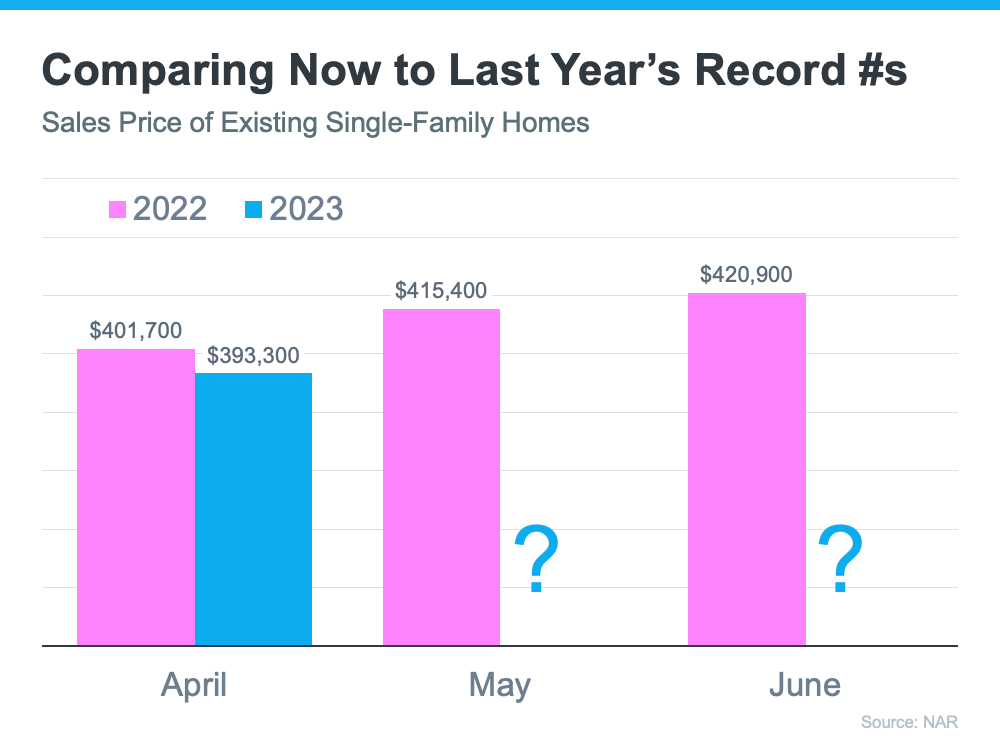
We’re about to enter a few months when home prices could possibly be lower than they were the same month last year. April, May, and June of 2022 were three of the best months for home prices in the history of the American housing market. Those same months this year might not measure up. That means, the Y-O-Y comparison will probably show values are depreciating. The numbers for April seem to suggest that’s what we’ll see in the months ahead (see graph below):

That’ll generate troubling headlines that say home values are falling. That’ll be accurate on a Y-O-Y basis. And, those headlines will lead many consumers to believe that home values are currently cascading downward.

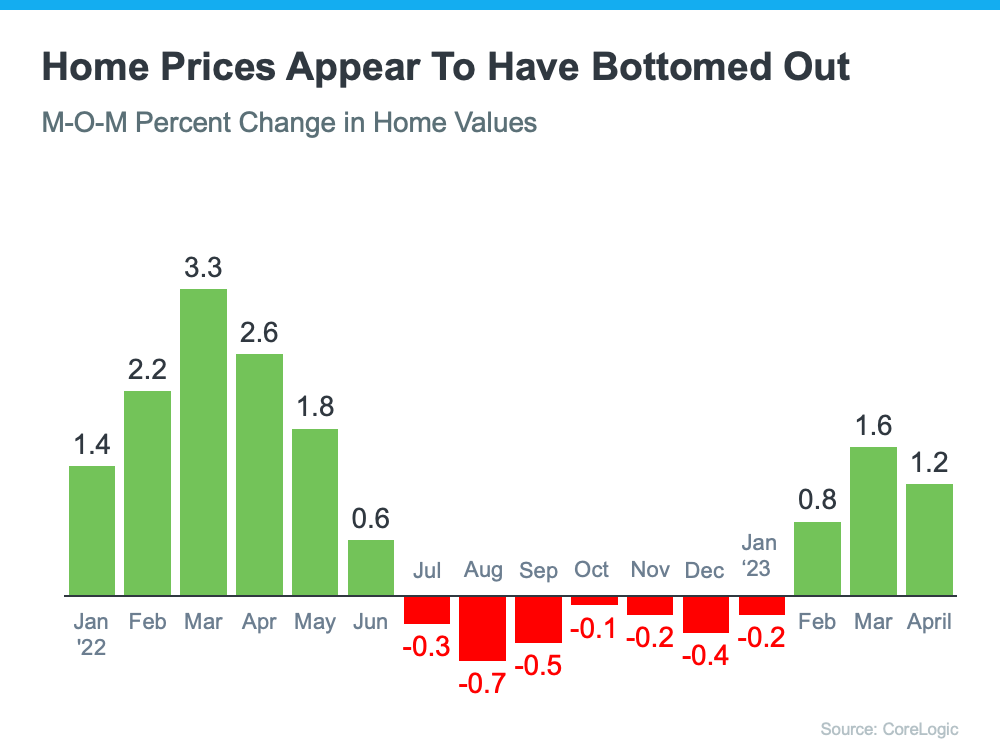
However, on a closer look at M-O-M home prices, we can see prices have actually been appreciating for the last several months. Those M-O-M numbers more accurately reflect what’s truly happening with home values: after several months of depreciation, it appears we’ve hit bottom and are bouncing back.

Here’s an example of M-O-M home price movements for the last 16 months from the CoreLogic Home Price Insights report (see graph below):

Why Does This Matter to You?

So, if you’re hearing negative headlines about home prices, remember they may not be painting the full picture. For the next few months, we’ll be comparing prices to last year’s record peak, and that may make the Y-O-Y comparison feel more negative. But, if we look at the more immediate, M-O-M trends, we can see home prices are actually on the way back up.

There’s an advantage to buying a home now. You’ll buy at a discount from last year’s price and before prices start to pick up even more momentum. It’s called “buying at the bottom,” and that’s a good thing.

Bottom Line

If you have questions about what’s happening with home prices, or if you’re ready to buy before prices climb higher, let’s connect.

Why You Can’t Compare Now to the ‘Unicorn’ Years of the Housing Market

Why You Can’t Compare Now to the ‘Unicorn’ Years of the Housing Market

Why You Can’t Compare Now to the ‘Unicorn’ Years of the Housing Market 

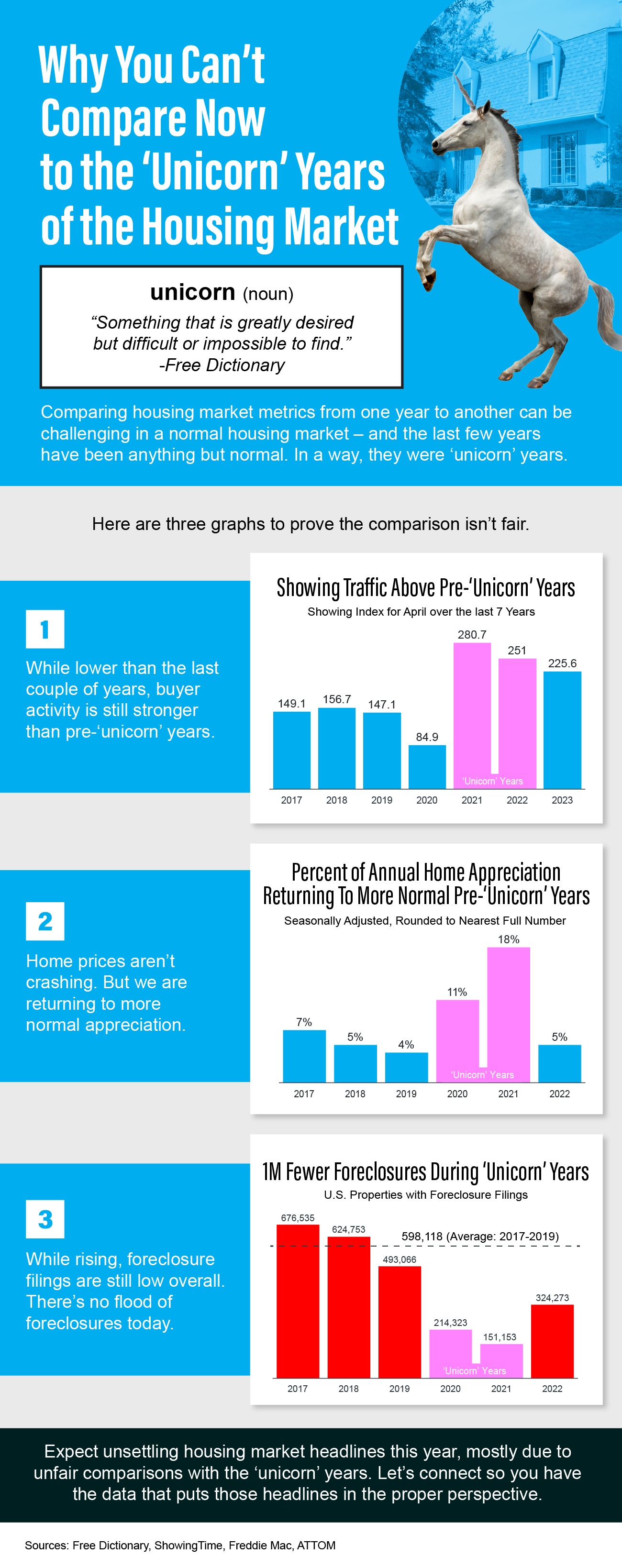
Some Highlights

  • Comparing housing market metrics from one year to another can be challenging in a normal housing market – and the last few years have been anything but normal. In a way, they were ‘unicorn’ years.
  • Expect unsettling housing market headlines this year, mostly due to unfair comparisons with the ‘unicorn’ years.
  • Let’s connect so I can share the data that puts those headlines in the proper perspective.

Marty Gale

Buy or Sell with Marty Gale

"Its The Experience"

Principal Broker and Owner of Utah Realty™

Licensed Since 1986

CERTIFIED LUXURY HOME MARKETING SPECIALIST (CLHM)

PSA  (Pricing Strategy Advisor)

General Contractor 2000 (in-active)
e-pro (advanced digital marketing) 2001
Certified Residential Specialist 2009

Certified Negotiation Expert 2014

Master Certified Negotiation Expert 2014
Certified Probate Specialist Since 2018

Senior Real Estate Specialist

Certified Divorce Specialist CDS


Contact me! 


Pin It on Pinterest